|
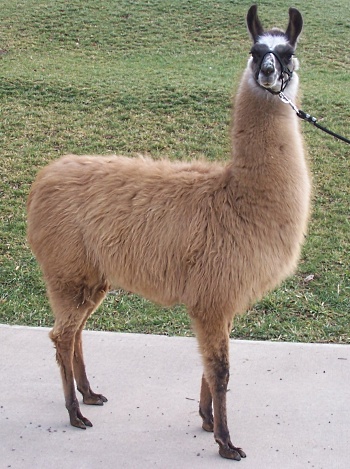
French Silk, aka Frenchy.
This first llama was crocheted.
|
I've managed to pull myself away from omgpop long enough to make some progress on knitting a llama from this
crochet pattern. I started by knitting the first foot and working up the leg, using the cylinder of the leg to measure my knit in the round gauge and comparing that to my crochet gauge. For comparison I was using the same yarn in a different color and needles and hook with the same mm rating.
Techknitter's disappearing loop cast on was essential as I never had a method for knitting a circle from the inside out before. That was one of the easy things to do in crochet that I wasn't sure I'd be able to do knitting. The second obstacle was figuring out how to knit a loop stitch. Actually, I found a few methods and all of them required me to turn the work when I got to loops rows just like crochet does. The technique I adopted was to draw a loop over my left index finger and then pull both of the loop strands through the stitch still on my left needle. (I knit continental.) Then I move the 2 strand loop from the right needle to the left needle and knit through the back loop the 2 new loops along with the one from the previous row that was still waiting on the left needle. I saw a method demonstrated on YouTube that uses American/English style, but I really don't want to convert to a method I find clunky and labor intensive. Not when I can hold the yarn in my left hand as if I was crocheting and have my left hand take up some of the work by pivoting back and forth. Seems there are a few variations which instruct one to alternate loop stitches rather than loop rows. I'm finding that loop and regular knit rows alternated seems to produce a greater row height than plain knit rows alone. Since I have many rows to alternate I'm just going to keep going and when I've knit more than an inch high I'll measure it and decide how to adjust the number of rows to knit.

I've completed one row with all four legs together, after knitting three legs at a time up to that point to catch them up to the first leg I started. I also took apart the first leg and added a few rows to it. I'd knit a single row of Miski Snowflake and left a really long tail of rust in the first leg specifically to give me the easiest method for adjusting the first leg if I needed to later. Using the row of snowflake as if it was waste yarn in the method Cat Bordhi defines for creating tentacles on her
Jester Tentacles Bag (Ravelry link) in her book
A Second Treasury of Magical Knitting I just turned the first leg inside out and freed the low end of rust. I caught loops from both the rust and snowflake yarn on dpns while unraveling one row from the loosened end. Then I split spliced (a.k.a. spit spliced) a ball of snowflake onto the loose end. I knit more rows in snowflake since I had variable amounts of that color on the feet of all the other legs and all of them were much more than a single row. Besides the first leg initially having significantly less snowflake color, I decided to add on a few more rows of knitting to the height of the leg, but had already completed two rounds of loop knitting at the top of the leg. Adding height with the snowflake color at the foot/leg junction was the ideal solution. Somehow I managed to add the first leg while having the foot point the opposite direction. Since the legs have no shaping, this shouldn't matter.
What makes knitting so completely superior to crochet?
The ability to work multiple items at the same time on the same needles is the best reason I can give. I'd started each of the feet individually and then worked them up to equal points and put them all on two circular needles. The same method that Cat Bordhi introduces in
Socks Soar on Circular Needles can be used to knit a single cylindrical type item in the round, but you also can continue to add extra work (I only do copies of the same item and line them up in the same place to avoid confusion) as long as you have a free end of yarn to knit with.
For socks, I wind up about half a hank of yarn into a center pull ball, then take if off the ball winder and set it into the middle of the box of my
Tilta Swift. I'll take the remainder of the hank off, turn it inside out so the inside end is on the outside, then using that end wind up a second center pull ball leaving the yarn that connects the two uncut. I usually drop these siamese twins into a small yarn sack and work from each end at the same time. It can be a bit funky casting on for two at a time. I really can't explain just how I do it myself even. Sometimes are clunkier than others. But with this method I can be assured that my socks really are twins. There are times (might not happen now) when I've had to make a decision about something and not been certain of exactly how I interpreted an instruction or improvised to be able to do the same thing again in a second sock. Finally, I really don't have the correct personality for doing the same thing two or four different times if I can make two or four versions at the same time. The only trick then, and you learn it fairly fast, is to make sure you are using the correct yarn end for each sock or item. Each one needs it's own end of yarn. This is a trick I use when I'm not sure I'm going to have enough yarn, like in the llama feet, but I want to use up as much as I can of the first color or want to be certain that the second color will start in exactly the same place on multiple items. (The llama legs don't start with a different color in the same place because I decided synchronized color changes was not a requirement for this project.)
With socks you will need to work one heel at a time at the part of the pattern where your rounds turn into rows. It's such a short amount of the whole that even I can manage it. The only other difficulty is when you are working patterns with decreases. The order for your work is to knit side A of sock 1 then side A of sock 2 then side B of sock 2 and side B of sock 1. You may find that you need to k2tog with one stitch on one circular needle and one on the other AND there is no way to reach it yet. If it's on the right end in the right direction (will usually be the second sock or the one that's on your left at the start of each new round) you just slip the stitch from one needle to the other. But if it's the last stitch on the first needle for the first sock you won't get to the second k2tog stitch until you've completed the second half of the second sock. But this is easy to work around by slipping the first k2tog stitch off onto a removable marker or suitable safety pin and then sliding the marker onto the second needle where the second stitch for the k2tog lives.

Currently I am using 3 balls of yarn to knit the four legs. This is also where my
Fiberspheres are shining. I am using the outside end and inside end of one ball at the same time in the large Fibersphere. And two small Fiberspheres are unfolded and then snapped together (like a figure 8) to hold each of the other two balls separately. I'm hoping for no big tangling problems and haven't had any so far. I'm trying to be very consistent about turning my work first one way and then the other (clockwise/counterclockwise) so that I'm not winding up the yarn strands for each half round. I'm winding and then immediately unwinding by turning in the opposite direction. (In retrospect, I found that the single ball of yarn strands twisted anyway, but with no tension on them they didn't actually tangle. I could easily push back the strand I wasn't using even though it spiraled around the other strand.)
I realize this would be better with more pictures to tell the story, but really, I'm not feeling up to illustrating all of it with examples. And there's probably information about this in other places that truly are more like resources anyway. I always look to Techknitter first when I have any question or challenge. She is amazing. Maybe later I'll mention how I
kitchener stitched the first leg back together using her knitting needle (not tapestry needle) method. Or I'll just link it now because I'm feeling lazy - no efficient. Efficiency rules.